
Most “AI for IT” pitches sound like a fairy tale: plug it in, watch the tickets disappear, and take a break. But anyone who’s actually managed a high-latency distributed system knows that logic without context is just high-speed nonsense. To navigate this shift, the question isn’t better prompts. It’s understanding where machine logic ends and where human judgment must begin.
In the rush to adopt AI in ITOps, the narrative is dominated by speed and scale. But for those building and running these systems, the shift is more nuanced—and more human.
Drawing from current shifts in agentic workflows and system architecture, here are 5 less discussed facts about how AI is shaping IT.
1. AI is Dissolving the “Silo Hierarchy” into UniOps
For decades, IT has been split into rigid domains: NetOps, SecOps, and ITOps. Humans need these silos because our cognitive bandwidth is limited—we need a specific “lane” to focus on.
The Truth: AI doesn’t see these boundaries.. When a latency spike hits, the LLM-driven agent sees only numbers, not the story behind them.. This is forcing a shift toward UniOps (Unified Operations), where the “Specialist” is being replaced by the “Orchestrator” who can manage an AI that spans the entire stack.
2. We are Trading “Mechanical Debt” for “Probabilistic Debt”
Everyone remembers the relief of fixing a broken script—one line, one bug, and a sense of achievement
The Truth: With GenAI, IT systems are becoming non-deterministic. You might have a system that works perfectly 99% of the time but fails on the 100th time because of a “fluency bias” or a slight shift in data patterns. Experts rarely admit that we are moving away from “fixing bugs” and toward “managing probabilities.” IT teams now have to build “Human Preprocessing Layers” just to audit the AI’s logic. It’s not just about fixing the code anymore; it’s about managing risk and being ready for the unexpected, together.
3. The “Seniority Gap” is Widening
The common hype is that AI “democratizes” IT, making juniors as good as seniors.
The Truth: The opposite is often true. AI is excellent at executing tasks (writing standard code, basic troubleshooting), but it struggles with intent and ambiguity. A senior engineer knows why a legacy system was built with a specific workaround; the AI only sees the patterns. Without that context, juniors risk becoming “copy-paste architects” who can’t debug the complex, interconnected failures that AI-generated systems eventually produce. The human experience here matters — the stories, the mentorship, the lessons learned after hours of trial and error.
4. “Attention” is a sought-after asset
AI can churn out disaster recovery plans or migration strategies in moments, but validation takes hours.
The Truth: IT leaders are finding that their teams are drowning in “Workslop”—AI-generated outputs that look polished but are riddled with subtle, high-risk errors. The real job of IT is shifting from Creation to Curation. If your team spends 4 hours reviewing a 15-minute AI output, your “efficiency gain” is a mirage. The tension, the focus, and the drive to get it right—all these are human qualities that cannot be replicated by machine speed.
5. EQ(emotional quotient or emotional intelligence) is becoming a Technical skill
In a crisis, AI can correlate millions of data points, but it cannot sense the mood in a war room.
The Truth: The most critical “failures” in modern IT aren’t hardware—they are coordination failures. Prioritization, judgment, and timing remain human problems. Kknowing when to pause, when to push, and when to realign is becoming a core technical capability.
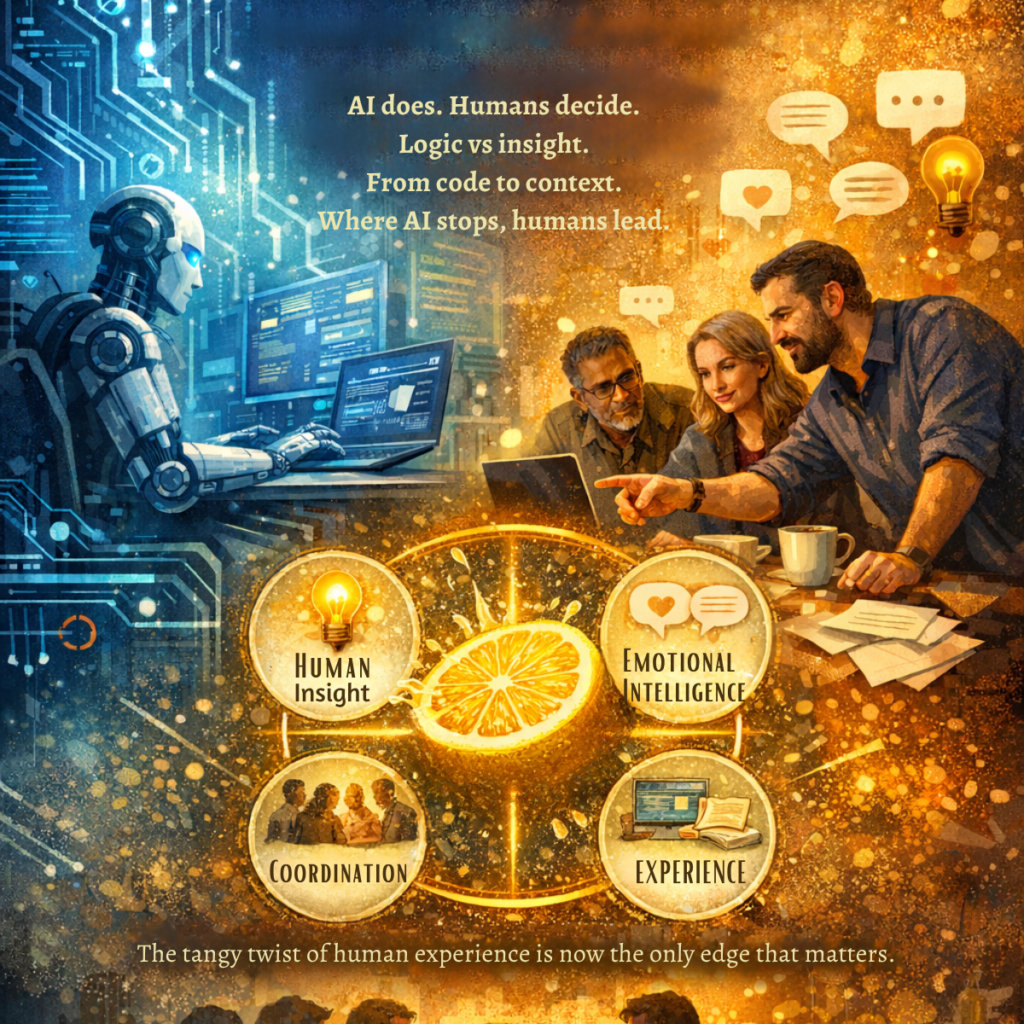
The Bottom Line: AI isn’t just a technical upgrade, it’s a rewrite of what it means to work in IT. The “Logic” (the execution) is being outsourced to the machines,. What remains is the “Lemon” (the sharp human insight, and judgment).
The value of IT professionals is shifting from producing output to validating truth—ensuring that what the machine generates is reliable, relevant, and safe.
The tangy twist of human experience is now the only edge that matters.
Note: Sharing a simple Logic & Lemon framework I’ve been using—it might help anchor where AI ends and human judgment kicks in.